Best App to Identify Garden Pests in 2026
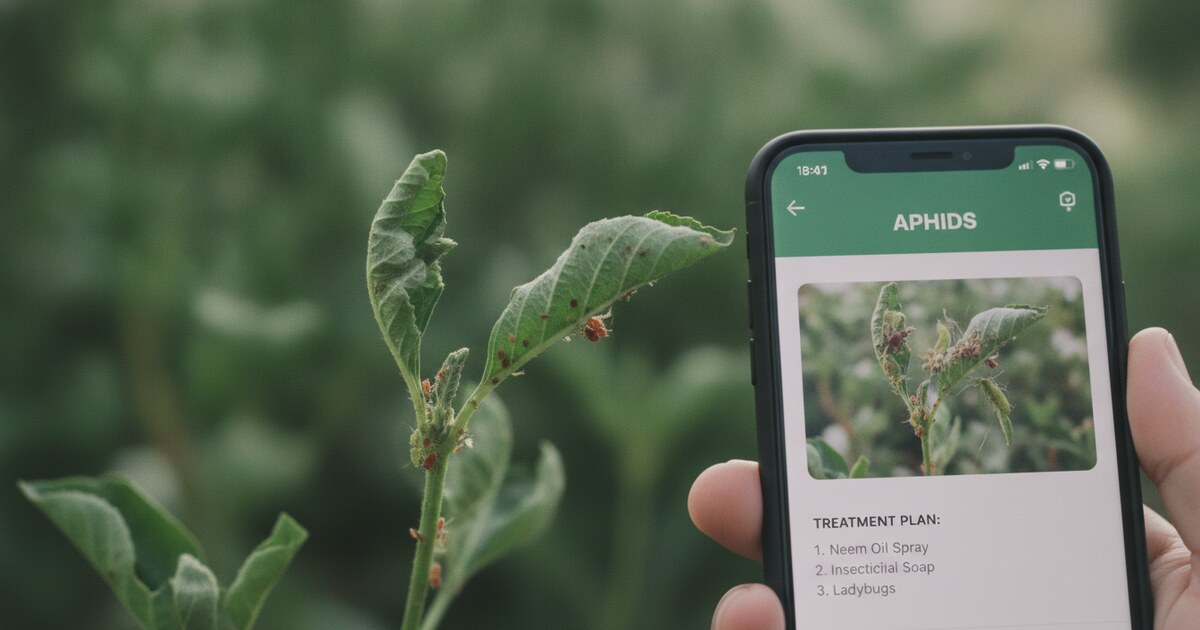
You spot stippled leaves on your tomatoes, ragged holes in your basil, or cottony clusters tucked under rose canes. Flipping through a field guide burns time you don’t have. Googling returns twenty possibilities and no real answer. The fastest path forward is a phone in your pocket and an app that puts a name to the problem in seconds.
Getting the ID right matters. Treating for aphids when you have spider mites wastes a week. Skipping treatment entirely lets the population triple. Finding the best app to identify garden pests is worth the two minutes it takes: the right one gives you a name and a treatment in one scan. Here’s how the top five options compare in 2026.
The best app to identify garden pests depends on what you need after the photo. For pure insect ID, Picture Insect covers 4,000+ species. For vegetable crops, Plantix is free and covers 780+ damage types. For diagnosis plus a treatment plan with organic and chemical options, PlantlyAI gives you both from a single scan.
What to Look for in a Garden Pest App
Before downloading anything, it’s worth knowing what actually separates a useful app from a mediocre one.
Speed and accuracy matter together. An app that takes 30 seconds to return a result is frustrating when you’re standing in the garden with a pest that moves. The best apps return a result in under 5 seconds on a clear photo.
Coverage scope varies. Some apps identify insects only. Others cover insects, diseases, nutrient deficiencies, and environmental damage in a single scan. If your garden runs to vegetables, fruit trees, and ornamentals, you want an app that handles all of them without switching tools.
Treatment guidance is where most apps fall short. Knowing it’s a Japanese beetle is a start. What you actually need is: which treatment works, how soon does it need to happen, and will that spray harm my pollinators? Apps that stop at the ID leave you Googling the answer anyway.
Garden pest apps work by running your photo through a trained image classification model. The model compares visual features in your photo against a labeled database of pest damage patterns, insect anatomy, and mold textures, then returns the closest matches with a confidence score. The better apps layer a second step on top: treatment protocols tied to that specific pest, including what beneficial insects prey on it naturally, which pesticides it’s resistant to, and whether the damage level warrants immediate action. Most apps reach 85-95% accuracy on clear, well-lit close-up photos. Accuracy drops on blurry shots, unusual angles, and early-stage damage that hasn’t developed visible symptoms yet. Photographing the pest itself (not just the damage) consistently returns more reliable results. Apps like PlantlyAI, Plantix, and Agrio train on crop images from multiple continents, giving them broader pest coverage than apps built for a single region. For home gardeners, that breadth matters because garden pests don’t respect geography.
Best Apps to Identify Garden Pests in 2026
1. PlantlyAI: Best for Diagnosis + Treatment
PlantlyAI does one job: take a photo of a struggling plant and tell you what’s wrong, then tell you how to fix it.
Snap a leaf, a stem, or a root ball. The AI identifies the pest, disease, or problem: aphids, spider mites, powdery mildew, root rot, nutrient deficiency. Then it hands you a treatment plan. You get three paths: organic, biological, or chemical. That choice matters when you’re growing food crops or trying to keep pollinators alive in the garden.
The app covers houseplants, garden flowers, vegetables, trees, and crops from a single scan. You get 2 free diagnoses per day with no account setup needed to start. A searchable plant disease library is built in for looking up problems by name.
Where PlantlyAI pulls ahead of pure insect ID apps is the treatment step. You don’t have to open a second app or Google the fix. The diagnosis and the remedy are in the same screen.
Best for: Gardeners who want the pest ID and the treatment plan in one scan.
2. Picture Insect: Best for Pure Bug Identification
Picture Insect is the specialist pick for insect identification. It covers 4,000+ species and returns results fast, with genus-level accuracy.
Built by Next Vision Limited, the app includes an insect encyclopedia, a bite reference guide (useful if the pest got to you before you got to it), and pest control tips for common garden species. You can log identified insects into a personal collection over time.
The limitation is scope. Picture Insect tells you what the bug is. It doesn’t diagnose plant health or give you a treatment plan tied to the damage pattern on your leaves. For identifying an unknown insect crawling across your kale, it’s excellent. For diagnosing why your pepper plants are dying, you’ll need something broader.
A premium subscription runs $39.99/year with a 7-day trial. The free tier limits scans.
Best for: Gardeners who encounter unknown insects and want precise species-level identification.
3. Plantix: Best for Vegetable and Crop Gardens
Plantix was built for farmers and works just as well for backyard vegetable growers. With 10 million+ downloads, it’s the most widely used ag-tech app globally.
It covers 780+ plant damage types across 30 major crops including tomatoes, peppers, cucumbers, potatoes, and wheat. A photo scan identifies diseases, pest damage, and nutrient deficiencies. The app surfaces treatment recommendations and regional disease alerts.
Plantix is free, which is a real differentiator. For food gardeners dealing with crop-specific pests (bacterial wilt on cucumbers, late blight on tomatoes, diamondback moth on brassicas), the coverage depth is hard to match at no cost.
The drawback: Plantix skews toward crop agriculture rather than ornamental houseplants or flowers. If your garden is mostly a vegetable patch, that’s not a drawback at all.
Best for: Vegetable growers and hobby farmers who need free, crop-specific pest and disease coverage.
4. Seek by iNaturalist: Best Free Option for Unknown Garden Visitors
Seek is the privacy-focused companion to iNaturalist. It identifies insects, plants, fungi, and animals from your camera, entirely free and no account required.
Point your phone at the insect and Seek identifies it in real time without uploading the photo. It draws from millions of wildlife observations logged on iNaturalist and surfaces commonly recorded species in your area. For common North American garden pests (aphids, whiteflies, caterpillars, beetles), it returns fast, reliable identifications.
What it doesn’t do: no treatment advice. Seek identifies what something is and stops there. If you find an unfamiliar insect and need to know whether it’s a pest or a beneficial (like a predatory ground beetle or a parasitic wasp), Seek answers that question well. The next step is on you: how to deal with it.
Free on iOS and Android.
Best for: Casual gardeners and families who want to identify garden visitors without a subscription, with no data collection.
5. Agrio: Best for Organic and Integrated Pest Management
Agrio is built by Saillog Ltd and wired around integrated pest management (IPM). The app identifies plant diseases, insect pests, and nutrient deficiencies, then defaults to organic and biological treatments before suggesting chemical options.
The models were trained on millions of crop images uploaded by growers worldwide. Agrio won the AgTech Breakthrough Award for its AI approach to plant disease identification.
Coverage extends beyond insects to fungal, bacterial, and viral diseases, plus nutrient deficiencies, abiotic stressors like wind and hail damage, and root problems. When the AI can’t pin down the issue, the app connects you to a human expert.
Free to use on iOS and Android.
Best for: Gardeners who prioritize organic methods and want treatment recommendations grounded in IPM principles.
Which App Should You Download?
The answer turns on what stops you in the garden.
You see an unfamiliar insect and want to know what it is: Picture Insect or Seek. Both handle thousands of species. Seek is fully free with no account needed and identifies in real time.
You grow vegetables or food crops and want to catch problems early: Plantix or Agrio. Both are free, both cover a wide range of crop-specific pests and diseases, and both give treatment guidance.
You have a plant that’s visibly sick and you need to know what’s wrong AND how to fix it: PlantlyAI. One photo returns a diagnosis and a treatment plan with organic, biological, and chemical options. For more on how dedicated diagnosis apps compare, see our breakdown of the best free app to diagnose plant problems.
Most active gardeners end up with two apps: a pure insect identifier for wildlife curiosity, and a plant diagnosis app for when something is actively going wrong.
How to Get Better Results From Any Pest ID App
Photo quality matters more than which app you pick. A blurry, shadowy shot will stump any AI.
Get close. Fill the frame with the affected area. If there’s an insect on the leaf, focus on the insect rather than the leaf.
Use natural daylight. Outdoor light shows colors and textures accurately. Direct flash blows out fine details like hairs and spots that the AI needs to make a correct call.
Photograph multiple angles. Shoot the pest directly, the damage pattern on the upper leaf surface, and the underside of the leaf where pests like to hide. Apps that process multiple photos return more reliable results.
Scan early. Early-stage damage is far easier to treat than a full infestation. If you catch spider mites when there are a dozen on one leaf rather than three thousand on fifty leaves, every treatment option is still on the table. For guidance on common houseplant pests and what to look for, see our article on spider mites on monstera as a practical example of how early ID changes the treatment window.
Pest ID apps are most useful when you build the habit of scanning anything that looks off, not just after the problem becomes obvious.
Frequently Asked Questions
Can an app accurately identify garden pests from a photo?
Yes, for common garden pests. Most AI-based pest apps reach 85-95% accuracy on clear, well-lit close-up photos of the pest itself. Accuracy drops on blurry shots, early-stage damage with no visible symptoms, and unusual angles. Photographing the pest directly rather than the damage it left behind consistently returns better results.
What’s the best free app to identify garden pests?
Seek by iNaturalist and Plantix are both fully free with no scan limits. Seek is better for quick insect ID with no account needed. Plantix covers more crop-specific disease and pest damage patterns, which makes it more useful for vegetable gardeners. PlantlyAI offers 2 free diagnoses per day with full treatment guidance included.
Do pest ID apps tell you how to treat the problem?
Most identification-only apps, like Seek and Picture Insect, don’t include treatment advice. Apps built for plant health like PlantlyAI, Plantix, and Agrio pair the identification with treatment recommendations. PlantlyAI goes furthest by giving organic, biological, and chemical options in one step.
Can these apps identify plant diseases as well as pests?
PlantlyAI, Plantix, and Agrio all diagnose diseases (fungal, bacterial, viral), pest infestations, and nutrient deficiencies from a photo. Picture Insect and Seek focus on insect identification and don’t cover plant diseases. If your garden problem could be a disease as easily as a pest, you need one of the full-diagnosis apps. See our guide to the best free plant disease app for houseplants for a deeper look at that category.
Does it matter which app I use for common pests like aphids or spider mites?
For very common pests, most apps return the right answer. The real differentiation shows up on less-common or early-stage problems. That’s where apps with larger training datasets (PlantlyAI, Plantix, Agrio) outperform general-purpose plant identification apps that weren’t built specifically for pest and disease diagnosis.
If a garden pest has you searching “what is eating my [plant]” before your first coffee, PlantlyAI cuts that loop short. Snap a photo, get the diagnosis, choose your treatment, and get back to the garden. Download PlantlyAI free on the App Store or Google Play. 2 free diagnoses per day, no account needed to start.
Not sure what's wrong? Diagnose your plant free
Upload a photo to our free plant disease identifier and get an instant diagnosis.