Spider Mites on Monstera: Signs, Causes & Treatment
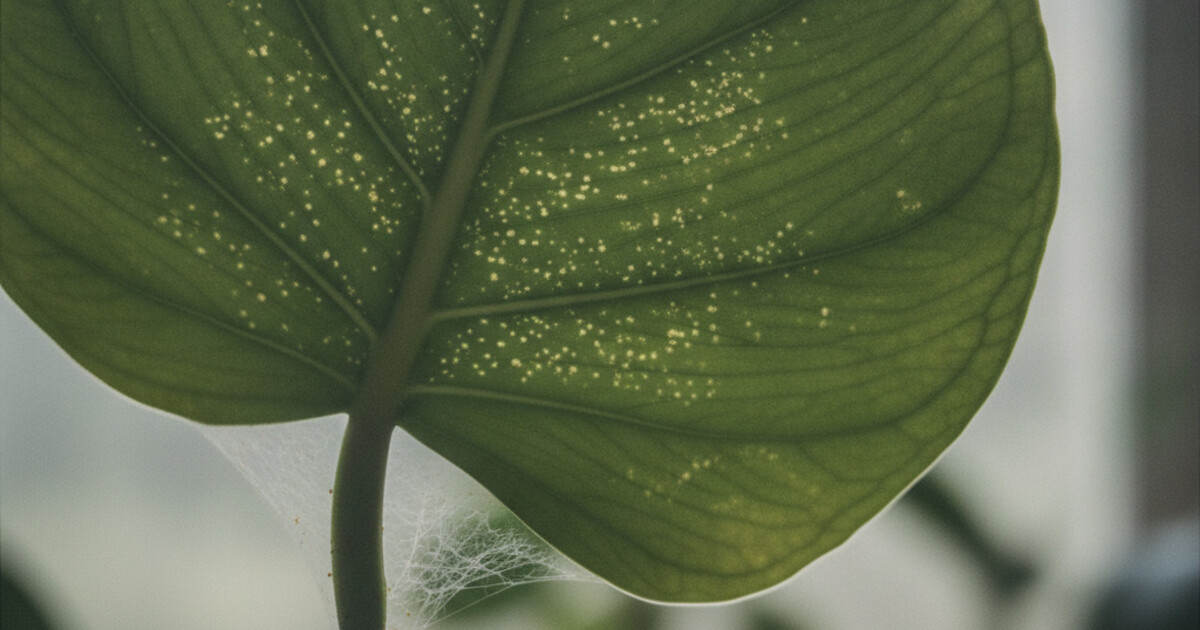
You checked your monstera last week and it looked fine. Now some leaves are dull, dotted with pale yellow specks, and there’s a faint wispy thread at a petiole junction. Spider mites work that fast. In warm, dry conditions a small colony can double in size in 5 days and spread across multiple stems within two weeks.
The good news is that spider mites on monstera are beatable at home, often without specialty products. Most people already have what they need: a shower, dish soap, and neem oil. The challenge is that the first signs are subtle. Many growers don’t spot an infestation until the webbing is obvious, at which point there are already thousands of mites on the plant. Getting ahead of that curve means knowing what to look for and acting immediately.
Quick answer: Spider mites on monstera appear as tiny pale yellow stipple dots across leaf surfaces, often with fine white webbing at joints and leaf undersides. Isolate the plant, blast mites off with water, then apply insecticidal soap or neem oil every 3 to 5 days for 3 weeks to kill each new generation of eggs as they hatch.
What Do Spider Mites Look Like on Monstera?
Spider mites are arachnids, not insects. The species most likely attacking your monstera is Tetranychus urticae, the two-spotted spider mite. Adults measure 0.3 to 0.5 mm, roughly the size of a grain of table salt. You won’t see them with the naked eye, but you’ll see what they leave behind: tiny pale or yellow dots (stipples) where they’ve punctured leaf cells to feed. Each mite punctures roughly 5 to 10 cells per day. A female T. urticae lays 100 to 200 eggs during her lifespan and at 80°F, a new generation hatches in just 5 to 7 days. Below 40% relative humidity, reproduction speeds up further. Webbing tends to appear once the population climbs into the hundreds per leaf surface. You’ll spot it first at petiole junctions and on leaf undersides, where mites shelter between feedings.
The simplest confirmation test: hold a white sheet of paper under a suspect leaf and tap the leaf firmly. Tiny moving dots on the paper are spider mites. If the dots sit still, they’re likely soil or dust. Mites move.
Other signs to check for:
- Stippling on the top surface of leaves (pale yellow or bronze dots in clusters)
- Webbing bridging two leaves or at stem joints
- Leaves turning yellow that started as just a few specks and spread outward
- Curling on young unfurling growth (mites often target new leaves first)
On monstera specifically, check the underside of fenestrated sections. Mites tend to concentrate along fenestration edges where airflow is lower.
Why Monstera Plants Get Spider Mites
Spider mites thrive in hot, dry conditions. When your home’s humidity drops below 40% in winter (central heating is the main cause), mites have ideal breeding conditions while your monstera is already stressed by the dry air.
Several factors make a monstera more vulnerable:
Low humidity. Below 50% relative humidity, T. urticae populations build much faster. Indoor winter air often sits at 25 to 35%, especially near radiators.
Heat near vents. A monstera placed beside a heating vent gets the warmth it wants but also the dry heat that mites prefer. Plants in these spots get infested repeatedly until moved.
Dusty leaves. Dust on leaf surfaces reduces gas exchange and makes it easier for mites to settle and establish. A monthly leaf wipe does more than most people realize.
Weakened plants. A monstera stressed by overwatering, underwatering, or nutrient deficiency can’t mount the minimal physical resistance (leaf wax, volatile compounds) that healthy plants produce. Stressed plants attract more pest pressure.
New plants brought home. This is the most common entry point. An infested cutting from a friend, a nursery plant, or even a bag of potting mix can carry spider mite eggs. The eggs survive in soil and hatched adults crawl or float onto nearby plants within days.
How to Get Rid of Spider Mites on Monstera
Treatment works in layers: physically remove as many mites as possible first, then apply a contact pesticide to kill survivors, then repeat to catch hatching eggs. Skipping any layer leaves the infestation intact.
Step 1: Isolate the plant. Move the infested monstera away from all other plants immediately. Spider mites spread through air currents and direct contact. Don’t wait until you finish reading this.
Step 2: Rinse with water. Take the plant to a shower or use a garden hose outdoors. Spray the undersides of every leaf with a firm, steady stream. This physically knocks off a large portion of the mite population. Let the plant drain completely before moving on.
Step 3: Apply insecticidal soap or neem oil. Mix insecticidal soap at the label’s recommended ratio (usually 2 tablespoons per quart of water) or use a ready-to-spray neem oil product. Cover every leaf surface top and bottom, every stem junction, and the top layer of soil. Mites hide in any crevice they can find.
Step 4: Repeat every 3 to 5 days for 3 weeks. Spider mite eggs resist most contact treatments. Only hatched nymphs and adults die from sprays. By retreating every 3 to 5 days, you catch each new generation as it hatches before it can reproduce. Consistency here is what ends the infestation.
Step 5: Wipe older leaves with rubbing alcohol. For mature monstera leaves with visible mite concentrations, dampen a cloth with 70% isopropyl alcohol and wipe each leaf surface. It kills on contact. Don’t spray alcohol directly onto soil.
Step 6: For severe infestations, use a miticide. If after two weeks of repeated treatment the population isn’t dropping, a miticide with bifenazate or spiromesifen provides faster knockdown. Rotate between products if you apply more than one round: T. urticae develops resistance to miticides within 5 to 7 generations.
How to Prevent Spider Mites from Coming Back
Clearing an infestation is only half the work. The other half is changing the conditions that let mites establish in the first place.
Keep humidity above 50%. A small humidifier near your plant collection, or grouping plants together to create a humid microclimate, makes the environment less hospitable to mites. Misting alone doesn’t raise ambient humidity enough to matter; you need a consistent source.
Wipe leaves monthly. A damp cloth wipe of top and bottom leaf surfaces removes dust, clears any early-stage mites, and lets you inspect for early stippling before the population grows. This is the easiest prevention habit to build.
Quarantine new plants for 2 weeks. Before placing any new plant near your monstera, keep it isolated in a separate room. Even plants from reputable nurseries occasionally carry eggs. Two weeks gives time for any eggs to hatch and become visible.
Check during water days. Most people water and move on. Taking 30 seconds to check a few leaves when you’re handling the plant catches infestations early. A colony of 20 to 30 mites per leaf clears with one rinse. A colony of thousands takes 3 weeks.
Keep the plant away from heating vents. If your monstera is near a vent or radiator for warmth, that placement raises your mite risk consistently. Good indirect light away from dry heat works better for long-term health.
How PlantlyAI Can Help Diagnose Monstera Pests
Monstera problems often stack. Monstera stem rot and spider mites can occur together because pest stress weakens the plant’s defenses against fungal pathogens. Spider mite stippling also looks a lot like early mineral deficiency, thrips damage, or scale if you don’t know what you’re looking for.
PlantlyAI takes a photo of your plant and returns a diagnosis identifying the specific pest, disease, or deficiency, along with a step-by-step treatment plan. It distinguishes spider mites from thrips, scale, and fungal spots based on visual damage patterns, so you’re treating the right problem from the start. Treatment options cover organic, biological, and chemical approaches, which matters if you’re gardening around children or pets.
If you’ve dealt with monstera root rot before and your plant is looking off again, a quick photo scan tells you whether you’re dealing with pests, rot, or something else entirely. Two free diagnoses per day, no account required. Download PlantlyAI on the App Store or Google Play.
Frequently Asked Questions
What are the tiny dots on my monstera leaves?
Tiny yellow or pale dots across monstera leaf surfaces are usually spider mite feeding stipples. Each dot marks a cell the mite punctured and drained. Check the leaf undersides: if you see small moving dots or fine webbing, spider mites are the cause. Mineral deficiency creates similar spotting but without webbing or visible moving pests.
Can spider mites kill a monstera?
Yes, though it takes a significant, sustained infestation. A monstera with thousands of mites loses so much leaf cell content that photosynthesis drops sharply. Young unfurling leaves can be destroyed before they open. An untreated infestation over several months causes steady decline and eventually kills the plant. Caught within the first few weeks, spider mites cause minimal lasting damage.
Does neem oil kill spider mites on monstera?
Neem oil kills spider mites on contact and disrupts their reproductive cycle through its active compound, azadirachtin. It works best when applied thoroughly to all leaf surfaces and repeated every 3 to 5 days. Neem doesn’t kill eggs, so the repeat applications are essential. Use cold-pressed neem oil with azadirachtin rather than clarified neem, which is processed and considerably weaker.
Why does my monstera keep getting spider mites?
Recurring infestations usually point to one of three things: low indoor humidity under 50%, a nearby plant reintroducing mites each time, or surviving eggs in the soil that weren’t treated during the original infestation. Check your ambient humidity with a hygrometer, quarantine all new plants for 2 weeks, and during treatment apply insecticidal soap to the soil surface to reach eggs there.
How long does it take to get rid of spider mites?
A light infestation with minimal webbing clears in about 2 weeks with consistent treatment every 3 to 5 days. A heavy infestation with visible webbing across multiple leaves takes 3 to 4 weeks. If active mites are still present at week 4, switch to a miticide with a different active ingredient. The population may have built resistance to the product you’re using.
Spider mites are one of the trickier houseplant pests because the early signs look like almost nothing. If you’re not sure whether your plant has mites, thrips, scale, or a deficiency, a photo diagnosis cuts out the guessing. PlantlyAI identifies the pest or disease from a single photo and gives you a specific treatment plan with organic options included. Download it free on iOS or Android and scan your monstera today.
Not sure what's wrong? Diagnose your plant free
Upload a photo to our free plant disease identifier and get an instant diagnosis.