How to Get Rid of Spider Mites on Houseplants
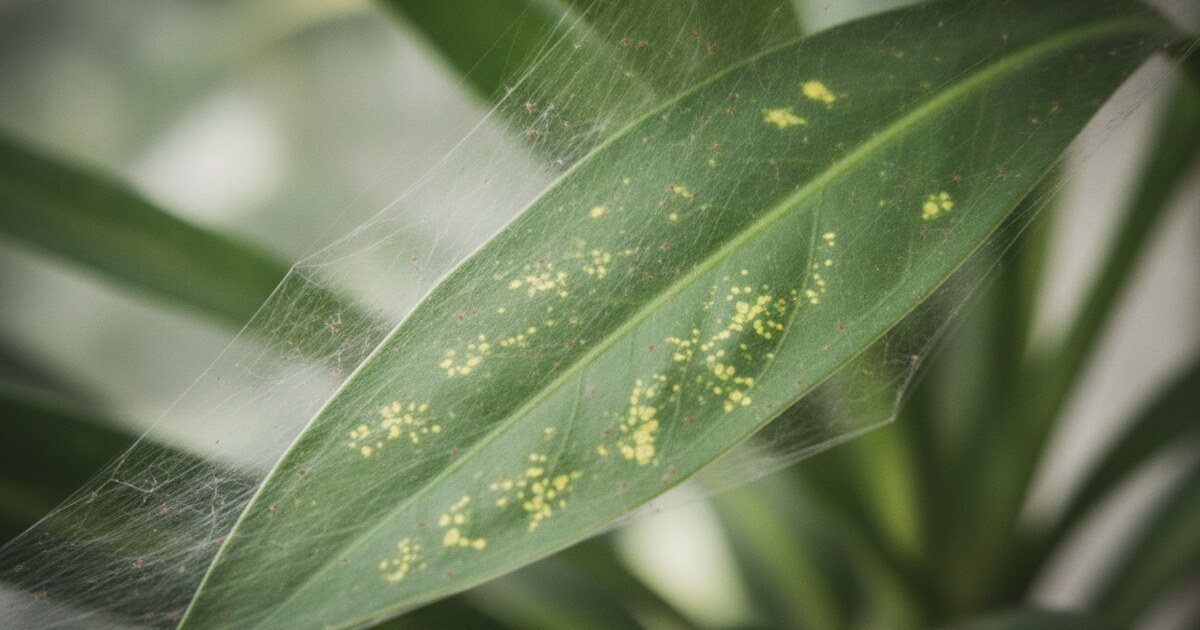
Spider mites are one of the hardest houseplant pests to deal with. They’re smaller than a pinhead, they live on leaf undersides where you rarely look, and a small colony can grow into a serious infestation within two weeks. A single treatment won’t fix it.
The good news: spider mites are very treatable if you catch them early and follow a consistent schedule. This guide covers identification, step-by-step treatment, and prevention so you can stop the cycle and save your plant.
Quick answer: To get rid of spider mites on houseplants, spray the entire plant (including leaf undersides) with 70% isopropyl alcohol or insecticidal soap, then repeat every 5-7 days for 3-4 weeks. One treatment won’t work because spider mite eggs survive most sprays. You need to kill each newly hatched generation before those mites can lay their own eggs.
How to Spot Spider Mites Before They Spread
Spider mites (the two-spotted spider mite, Tetranychus urticae, is the most common species on houseplants) are barely visible to the naked eye. Adults measure less than 0.4 mm. You’ll usually notice the damage before you spot the mites themselves.
Signs you have spider mites:
- Tiny yellow or white speckling (stippling) on leaf surfaces, as if the leaf was dotted by a fine needle
- Fine, silky webbing across leaves, between stems, or in the junction where leaves meet the stalk
- Dull, dusty-looking foliage with no obvious cause
- Leaves turning bronze, silvery, or papery in patches
Hold a white piece of paper under a branch and give the leaves a tap. If tiny specks fall and start moving, those are spider mites.
Leaf undersides are where mites spend most of their time. Run your finger along the underside; a gritty, dusty texture confirmed under a magnifying glass means there’s a colony.
Spider mites can look similar to early thrips damage (silvery streaks, stippling), so if you’re uncertain, our guide on getting rid of thrips on houseplants walks through how thrips damage differs. Monsteras are a frequent target and show these signs clearly, as covered in our spider mites on monstera guide.
Mites thrive in hot, dry conditions. Houseplants near heaters, south-facing windows in summer, or in rooms with low humidity are most at risk. Winter heating is a major trigger: indoor humidity can drop to 20-30% when central heating runs, and mites reproduce fastest below 50% humidity.
Why Spider Mites Are Hard to Kill
The reason a single treatment fails is the egg cycle. Tetranychus urticae females lay more than 100 eggs per lifetime. At room temperature (70-80°F), a single generation (egg to egg-laying adult) completes in 7-14 days.
In a warm, dry house running above 80°F, that cycle compresses to just 5-7 days. Most treatments (isopropyl alcohol, insecticidal soap, neem oil) kill adults and nymphs on contact but don’t reliably destroy eggs. That means the eggs already on your plant continue hatching after you treat, and the population rebounds within a week if you stop.
Low humidity accelerates everything. Below 50% relative humidity, spider mites reproduce faster and their eggs hatch sooner. Central heating in winter typically drops indoor humidity to 20-30%, which is why spider mite infestations spike between November and March.
The Ohio State University Extension reports that a detection threshold of roughly 10+ mites per sample leaf indicates the population is already multiplying faster than spot-checks will reveal. At 80°F with low humidity, generations overlap: while you’re killing adults, the eggs laid three days earlier are already hatching into nymphs.
This is why most gardeners treat once, see improvement, and find the mites back in two weeks. This biology shapes the only treatment schedule that works: spray every 5-7 days for 3-4 weeks to catch each new generation as eggs hatch, before those freshly hatched mites mature and lay their own eggs. Stopping early is the single biggest reason spider mites come back.
How to Treat Spider Mites on Houseplants Step by Step
Step 1: Quarantine immediately. Move the affected plant away from every other houseplant. Spider mites spread by crawling and by contact when leaves brush against neighboring plants. Distance stops the infestation from jumping to new hosts while you treat.
Step 2: Remove heavily damaged leaves. Leaves with dense webbing or severe stippling over most of the surface are already dying. They also carry the highest mite concentration. Cut them off, seal them in a plastic bag, and discard. Don’t compost.
Step 3: Rinse the plant under running water. Take the plant to a sink or shower. Rinse every surface with a strong stream, paying close attention to leaf undersides. This physically knocks off adults, nymphs, and loose webbing; it won’t destroy eggs, but it cuts the active population sharply before you spray.
Step 4: Apply your treatment, covering everything. Spray the entire plant top to bottom. Target leaf undersides first. Saturate stem junctions and any remaining webbing. Let the treatment air dry. Do not rinse it off.
Step 5: Repeat every 5-7 days for at least 3-4 weeks. Set a calendar reminder. Don’t skip a cycle because the plant “looks better.” Eggs laid before your first treatment can keep hatching for 2-3 weeks. The fourth or fifth treatment is often the one that finally breaks the infestation completely.
Which Treatments Actually Work
70% isopropyl alcohol is the most effective contact treatment. Dilute it 50/50 with water for sensitive plants (ferns, orchids, and some succulents can react), or use the 70% solution directly on hardier foliage. Always test on one leaf first, wait 24 hours, then treat the whole plant. Re-apply every 5-7 days.
Insecticidal soap breaks down the mite’s outer coating on contact. Works well on light-to-moderate infestations. Use a commercial formulation rather than household dish soap (see the FAQ below) for better results and less leaf damage risk. Apply every 5-7 days.
Neem oil disrupts mite reproduction and repels adults but is slower-acting than alcohol. Mix 1-2 tablespoons neem oil with 1 teaspoon liquid dish soap and 1 liter of water; best used after a contact spray to add a repellent layer. Apply in the evening to avoid leaf scorch.
Predatory mites are the best option for severe infestations or large collections where repeated spraying isn’t practical. Phytoseiulus persimilis eats only spider mites and their eggs; one packet of 1,000 predatory mites typically treats 5-10 heavily infested plants. Available from biocontrol suppliers online, no chemical sprays needed.
What doesn’t work reliably:
- Hydrogen peroxide (inconsistent kill rate on adults, degrades in minutes)
- Essential oils alone (mild repellent effect, doesn’t eliminate established colonies)
- Wiping leaves with a dry cloth (physically spreads mites and eggs to new areas)
Can You Save a Plant With Spider Mites?
Yes, in most cases. The stippling and bronze discoloration you see on affected leaves is permanent damage to those individual cells, but it doesn’t kill the leaf, and the plant will produce new, healthy growth once the infestation clears. The damaged leaves can stay on the plant.
When to treat vs. when to discard:
A light infestation (a few speckled leaves, minimal webbing visible only on undersides) has a high recovery rate with consistent treatment. Most plants come through fine.
A moderate infestation (multiple branches showing stippling, webbing visible across several nodes) is treatable. Expect 4-6 weeks of effort. The plant will look rough during treatment but bounce back.
A heavy infestation (entire plant wrapped in dense webbing, most leaves stippled or dead, mites visible on every surface) is more complicated. If more than 60-70% of the foliage is already destroyed and the webbing is thick across every branch, the plant may be too far gone.
Treating a heavily infested plant for weeks while it sits near other plants risks spreading the infestation to your whole collection. Discarding and starting fresh is sometimes the right call.
If you’re unsure whether the damage you’re seeing is actually spider mites or something else, PlantlyAI can help. Take a photo of the affected plant, and the app identifies the pest or disease and gives you a step-by-step treatment plan. It’s free with 2 diagnoses per day and requires no account to start.
How to Prevent Spider Mites From Coming Back
Raise humidity. Spider mites struggle to reproduce above 60% relative humidity. A pebble tray filled with water under susceptible plants, grouping plants together, or a small humidifier nearby all help. This single change makes your plants significantly less attractive to mites long-term.
Quarantine every new plant. Most infestations start when a new plant comes home carrying eggs or adults. Keep new additions separate for 2-3 weeks before placing them with your collection. Check leaf undersides before the quarantine ends.
Inspect leaf undersides regularly. Make it a habit on susceptible plants (palms, prayer plants, orchids, monsteras, ficuses) every 2-3 weeks. Catching 5-10 mites at week 1 takes one treatment. Catching 5,000 at week 4 takes a month.
Avoid hot, dry conditions near heating vents. Move susceptible plants away from radiators and heating registers in winter. If a plant has to stay near a heat source, boost the humidity around it actively.
Keep plants healthy overall. Stressed plants (drought, low light, root-bound) are more vulnerable and recover more slowly. A well-watered, properly lit plant resists mite damage better and bounces back faster when infestations occur.
Frequently Asked Questions
What kills spider mites instantly? 70% isopropyl alcohol diluted 50/50 with water kills adult spider mites and nymphs on direct contact. Spray it on, make sure it coats leaf undersides, and let it dry. The kill is fast but limited to the mites the spray physically touches. Eggs on the leaf surface survive, which is why you need to repeat the treatment every 5-7 days for 3-4 weeks as eggs hatch.
Can you save a plant that has spider mites? Yes, in most cases. Plants with light-to-moderate infestations recover well with consistent treatment over 3-4 weeks. The stippling and bronze color on damaged leaves is permanent, but those leaves don’t die and new healthy growth emerges once the mites are gone. Only consider discarding if more than 60-70% of the foliage is destroyed or the webbing is so dense the plant can’t be treated effectively without spreading mites to other plants.
How do I get rid of spider mites without killing my plant? Use insecticidal soap or diluted neem oil (1-2 tbsp neem plus 1 tsp dish soap per liter of water). Both are gentler on foliage than straight isopropyl alcohol. Test any treatment on one leaf first and wait 24 hours before applying to the whole plant. Rinse the plant with water before spraying to knock off the bulk of the active population, then apply the treatment. Repeat every 5-7 days.
Does Dawn dish soap kill spider mites? Dish soap has limited effectiveness on its own. Sprayed directly, it can disrupt a mite’s outer coating, but it’s inconsistent and concentrated solutions damage foliage (yellowing, leaf scorch). If you use it, keep concentration very low: 2-3 drops per liter of water, and rinse the plant 24 hours after treating. A commercial insecticidal soap formulated for plants is more effective and safer for foliage.
How do spider mites get on indoor plants? Spider mites come in on new plants, on cut flowers, through open windows in summer, on clothing after gardening outdoors, or through infested soil. They can travel short distances on air currents as well. Once inside, they spread plant to plant by crawling, especially when leaves touch. Quarantining new plants for 2-3 weeks before adding them to your collection stops most introductions before they start.
Clear the Infestation for Good
Spider mites are persistent because the egg cycle keeps rebuilding the population after every single treatment. The fix is simple, just not fast: spray every 5-7 days for 3-4 weeks, keep humidity above 50%, and inspect leaf undersides regularly. Most plants recover completely.
If you want a faster diagnosis of exactly what pest you’re dealing with, or you’re not sure whether your plant is worth saving, PlantlyAI can help. Take a photo of any affected leaf and the app identifies the problem and gives you a treatment plan with organic, biological, and chemical options. Free with 2 diagnoses per day, no account needed. Download on the App Store or Google Play.
Not sure what's wrong? Diagnose your plant free
Upload a photo to our free plant disease identifier and get an instant diagnosis.