How to Get Rid of Whiteflies on Indoor Plants
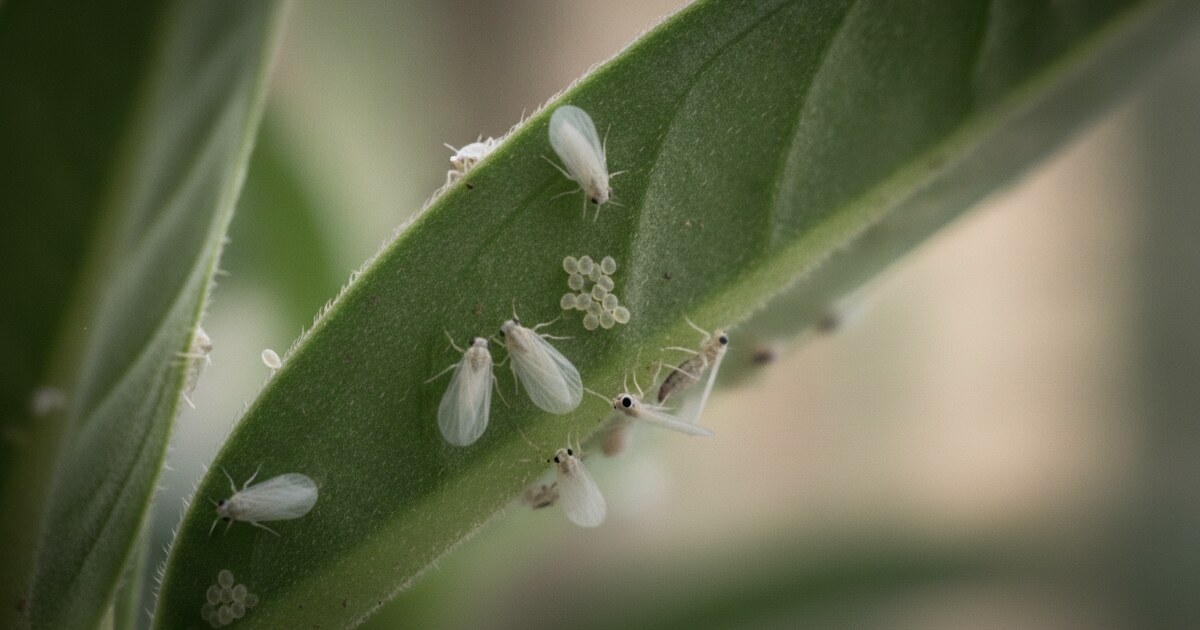
You go to water your plant and a tiny white cloud lifts off the leaves. That’s whiteflies. If you’ve seen that cloud, the infestation is already larger than it looks. Most of the colony is hiding on leaf undersides as immobile nymphs and eggs, invisible until they’re disturbed. The good news: whiteflies respond well to treatment when you catch them early and repeat your approach consistently.
To get rid of whiteflies on indoor plants, isolate the plant, spray insecticidal soap on all leaf surfaces every 3-5 days for 3 weeks, and add yellow sticky traps for flying adults. Heavy infestations need neem oil layered in every 7 days. Repetition is what breaks the lifecycle.
What Whiteflies Are and Why They’re Hard to Kill
Whiteflies are sap-sucking insects in the order Hemiptera, more closely related to aphids and scale insects than to houseflies. They colonize leaf undersides and reproduce rapidly in warm indoor conditions.
Two species cause most houseplant problems: the greenhouse whitefly (Trialeurodes vaporariorum) and the silverleaf whitefly (Bemisia tabaci). Both pass through four nymph stages before reaching adulthood. The first three stages are mobile crawlers that actively feed on leaf undersides. The fourth stage is a stationary pupa resembling a flat scale; it doesn’t move and resists contact sprays, which explains why a single treatment isn’t enough. At 75°F (24°C), the full lifecycle from egg to adult completes in 25-30 days. Eggs hatch in 5-8 days. A single female lays 200-400 eggs over her lifetime, so an untreated plant can produce a population of several thousand within 8-10 weeks. Adults are 1-2mm long with white waxy wings and cloud off leaves when disturbed. Feeding drains phloem sap, causing chlorosis (yellowing) and stunted growth. The sticky honeydew whiteflies excrete attracts sooty mold (Capnodium sp.), which coats leaves and reduces photosynthesis further.
That pupal resistance is the core reason whitefly treatment takes weeks, not days. Contact sprays kill adults and crawling nymphs on contact but can’t penetrate the pupal shell. You need to keep treating as each generation hatches.
Signs Your Plant Has Whiteflies
The clearest sign is that white cloud when you disturb the plant. Beyond that, watch for:
- Tiny white specks on leaf undersides (eggs and immobile nymphs)
- Yellowing leaves that don’t trace back to watering problems
- Sticky film or honeydew residue on leaves and surfaces below the plant
- Sooty black mold growing on top of the sticky film
- Tiny white-winged adults resting on leaf undersides in clusters
Symptoms build gradually. By the time leaves start yellowing significantly, you’re likely dealing with several overlapping generations.
How to Get Rid of Whiteflies on Indoor Plants: Step by Step
Work through these steps in order. Isolation is the single most important first step because whiteflies spread easily between plants in the same room.
Step 1: Isolate the plant immediately. Move it away from your other plants. Check everything nearby and isolate any plant showing similar symptoms.
Step 2: Remove heavily infested leaves. If a leaf is packed with nymphs and eggs, pinch it off and seal it in a bag before tossing it. Don’t compost infested material.
Step 3: Place yellow sticky traps. Set 1-2 traps near the plant at leaf height. Whiteflies fly toward yellow and get stuck. Traps catch flying adults efficiently and give you a clear monitoring tool to watch whether numbers drop week to week. They work best as part of the full treatment approach.
Step 4: Rinse the plant. Bring it to the sink or shower and rinse leaf surfaces (top and bottom) with room-temperature water. This dislodges adults and some mobile nymphs. Let it drain fully before treating.
Step 5: Apply insecticidal soap spray. This is your primary treatment. Mix a ready-to-use insecticidal soap or make your own: 1 tablespoon of pure castile soap per quart of water. Coat every leaf surface, paying close attention to undersides where nymphs cluster. Repeat every 3-5 days for at least 3 weeks. Soap kills on contact by disrupting cell membranes, so there’s no residual protection; consistent repeat applications are what do the work.
Step 6: Layer in neem oil. Neem oil contains azadirachtin, which disrupts molting and feeding in immature stages. Spray every 7 days, alternating with your soap treatments. Shake the solution thoroughly before use since it separates fast, and apply in early morning or evening to avoid leaf burn.
Stick to this schedule and monitor your sticky traps weekly. A declining catch rate is your signal the population is collapsing.
Organic and Chemical Treatments That Work
Insecticidal soap (contact kill): Most effective against crawling nymphs and flying adults. No residual action, so repeat every 3-5 days. Use pure castile soap or a commercial insecticidal soap; regular dish soap with surfactants or fragrances can scorch leaves.
Neem oil (growth disruptor): Azadirachtin blocks molting hormones in nymphs. Apply every 7 days. Works best combined with soap rather than used alone.
Pyrethrin spray (fast knockdown): Derived from chrysanthemum flowers and classified as organic. Kills adults on contact quickly but breaks down within hours, leaving no residual. Useful for a heavy adult flush, but it won’t touch eggs or pupae.
Horticultural oil (suffocation): Smothers eggs and nymphs when applied thoroughly. Best used in combination with soap and neem.
Imidacloprid soil drench (systemic, last resort): Absorbed through the roots, moves through the plant’s vascular system, and poisons insects feeding on sap. One application protects for 6-8 weeks. Reserve this for severe infestations where 3 weeks of topical spray hasn’t worked. Don’t use it on edible plants or where pollinators can reach open flowers.
For most houseplant infestations, insecticidal soap plus neem oil clears the problem within 3 weeks. The same repeat-application logic applies to thrips on houseplants: both pests require consistent treatment schedules over multiple weeks to break every overlapping generation.
How PlantlyAI Can Help Diagnose Whitefly Infestations
Whitefly symptoms overlap with mealybug and scale damage (the sticky honeydew, the yellowing, the slow decline). If you treat for the wrong pest, you waste weeks.
PlantlyAI diagnoses plant problems from a photo. Snap a picture of the affected leaves, and the app identifies the pest or disease, then gives you a step-by-step treatment plan with organic, biological, and chemical options. You get 2 free diagnoses per day with no account required on iOS and Android.
A confirmed diagnosis before you start treating means you buy the right products and follow the right schedule from day one.
How to Prevent Whiteflies from Coming Back
Most indoor whitefly infestations arrive on new plants from a nursery. Prevention starts before anything enters your home.
Inspect before you buy. Flip a few leaves at the nursery and look for tiny white insects, egg clusters, or sticky residue. Pass on any plant that looks infested.
Quarantine new plants for 2 weeks. Keep new arrivals isolated from your collection and check them every 2-3 days. Even a clean-looking plant can carry eggs that haven’t hatched yet.
Keep yellow sticky traps as permanent monitors. One trap near your plant area gives early warning of a new infestation. Catching 2-3 whiteflies in a week is an opportunity to address the problem before it becomes a colony.
Avoid over-fertilizing with nitrogen. High-nitrogen feeding produces lush, soft new growth, exactly the kind whiteflies prefer. Feed at the recommended rate.
Improve air circulation. Stagnant warm air accelerates whitefly reproduction. A small fan on low nearby helps, especially in the warmer months.
Frequently Asked Questions
Can whiteflies kill my plant?
A small infestation rarely kills a healthy plant directly. Severe or prolonged infestations weaken plants through sustained sap loss, and the sooty mold that builds up from honeydew can block enough light to cause serious decline. Treat at the first sign, and most plants recover fully.
How long does it take to get rid of whiteflies on indoor plants?
Plan for 3-4 weeks of consistent treatment. The lifecycle completes in 25-30 days at room temperature, so you need at least that long to work through every overlapping generation. Most infestations are under control in 3 weeks if you hold the spray schedule.
Do whiteflies live in soil?
No. Whiteflies spend their entire lifecycle on plant tissue: eggs, nymphs, and pupae on leaf undersides, adults in the air around the plant. Soil drenches don’t help unless you’re using a systemic insecticide absorbed through the roots (like imidacloprid).
Can whiteflies spread to other plants in my home?
Yes, easily. Adults fly readily and transfer on clothing, tools, or water splash. Isolating the infested plant immediately is the most important first step. Once you’ve gone 2 weeks without catching adults on sticky traps, it’s generally safe to move the plant back.
Does wiping leaves remove whiteflies?
Wiping removes adults and some mobile nymphs but misses eggs and pupae tucked along leaf veins. Use it as a first step, not a primary treatment. Follow up with insecticidal soap and neem oil sprays.
Whiteflies multiply fast once they’re established. The adults you see flying represent a fraction of the colony. Three weeks of consistent insecticidal soap and neem oil treatments, backed by yellow sticky traps, clears most indoor infestations.
If you’re not certain you’ve identified the pest correctly, photograph the affected leaves with PlantlyAI. The app confirms the diagnosis and gives you a treatment plan tailored to what it finds, so you’re treating the right problem from the start.
Not sure what's wrong? Diagnose your plant free
Upload a photo to our free plant disease identifier and get an instant diagnosis.