White Fuzz on Succulent Leaves: Causes & How to Fix It
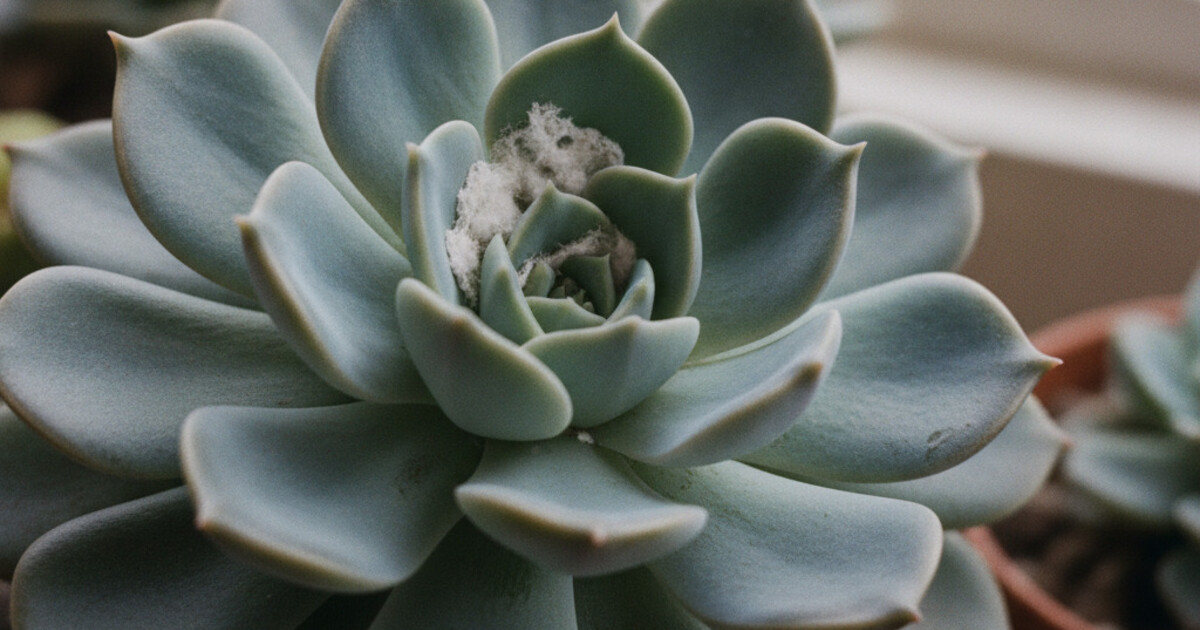
You spot white fuzz on succulent leaves and immediately wonder whether to grab the alcohol swab or leave the plant alone. That question matters, because the right answer is completely different depending on what you’re actually looking at.
White fuzz on succulents comes from three sources: mealybugs, the plant’s natural wax coating (farina), or powdery mildew. Mealybugs spread and need fast removal. Farina is the plant’s built-in defense against UV radiation, and wiping it off causes permanent damage. Powdery mildew needs better airflow and possibly a fungicide.
White fuzz on succulent leaves has three causes: mealybugs, natural farina wax, or powdery mildew. Mealybugs form cottony clusters in leaf joints, spread fast, and need immediate treatment. Farina is an even dusty coating across the full leaf surface of species like Echeveria that protects against UV damage. Powdery mildew appears as a flat white film triggered by poor airflow.
White Fuzz on Succulents: Is It Mealybugs, Farina, or Mildew?
The three causes have distinct visual signatures when you look closely.
Mealybugs (family Pseudococcidae) are the most destructive source of white fuzz on succulents. A single female deposits 100-300 eggs in a cottony wax sac in leaf axils and stem joints; those eggs hatch in 6-14 days into crawlers that spread to neighboring plants by direct contact and shared soil. As mealybugs feed, they pierce leaf cells and extract sap, causing shriveling, yellowing, and leaf drop. They also excrete honeydew, a sticky residue that leads to sooty mold. Farina, by contrast, is an epicuticular wax produced by succulents such as Echeveria, Graptoveria, Dudleya, Pachyphytum, and Sedeveria as a defense against UV radiation and water loss. It coats the entire leaf surface evenly with a dusty blue-grey or silver sheen, rather than clustering in joints. Powdery mildew (Erysiphales order fungi) appears as a flat, dry white coating on leaf surfaces, triggered by high humidity or poor airflow, and spreads across multiple leaves at once.
Mealybug clusters feel loose and fluffy when you press a cotton swab against them. Farina feels waxy and smooth. Powdery mildew feels powdery and dry.
That tactile test, combined with where the white material sits on the plant, usually settles the question within seconds.
How to Identify Mealybugs on Succulents
Start with a close look at the base of the plant and the joints where leaves meet the stem.
Mealybugs prefer sheltered spots: deep leaf axils, stem nodes, the soil surface near the base, and the underside of leaves. On compact rosette succulents like Echeveria or Haworthia, they hide 3-4 layers deep in the rosette where sprays struggle to reach. The white clusters look like small bits of cotton or lint. If you press a cotton swab against a cluster, it leaves an orange or yellow smear on the swab rather than wiping clean.
Other signs that confirm mealybugs rather than farina or mildew:
- Sticky, shiny residue (honeydew) on leaves below the white fuzz
- Sooty mold: a dark grey-black film on leaves that forms on dried honeydew deposits
- Wrinkled or shriveled leaves near the infestation site
- Individual insects visible under magnification (1-4mm, oval, segmented, covered in waxy filaments)
- Ants clustering on the plant, which farm mealybugs for their honeydew
Root mealybugs are harder to catch. They stay underground and cause slow decline, yellowing, and wilting without any visible surface pests. If the plant looks sick despite no obvious problems above soil, unpot it and check the root zone for white waxy clusters at the base.
How to Treat White Fuzz from Mealybugs
Speed determines how much work this takes. A colony caught in week one is a 20-minute job. One left untreated for a month becomes a multi-week treatment cycle.
Step 1: Isolate the plant. Move it away from everything else immediately. Mealybug crawlers spread through direct contact and can travel between pots.
Step 2: Remove visible insects manually. Dip a cotton swab in 70% isopropyl alcohol and press it firmly onto each white cluster. The alcohol dissolves the waxy coating and kills on contact. For deep rosettes, use a soft toothbrush dipped in the same alcohol to scrub crevices the swab won’t reach.
Step 3: Spray the whole plant. Mix 70% isopropyl alcohol 50/50 with water in a spray bottle and coat every leaf surface, stem, and the top soil layer. Test a small area first and wait 48 hours if you haven’t done this before; most succulents handle it well, but a few thin-leaved varieties show slight bleaching.
Step 4: Follow with neem oil. Neem oil coats surviving eggs and crawlers and blocks their development. Mix 1 teaspoon neem oil with 1 teaspoon dish soap per liter of water and apply in the evening to avoid leaf scorch.
Step 5: Repeat every 7-10 days for 4-6 weeks. Most people quit after one treatment and the infestation rebounds. The repeat schedule targets newly hatched crawlers before they reach reproductive maturity and breaks the full egg cycle.
For a complete walkthrough of the mealybug treatment protocol, including how to handle root mealybugs and treat a large collection, the guide on mealybugs on succulents covers each step in detail.
White Powdery Mildew on Succulents
Powdery mildew on succulents is a fungal disease, not a pest, and it responds to different treatment entirely.
It appears as a flat, dry, white-to-grey coating spread across leaf surfaces rather than clustered in crevices. You’ll often see it across multiple leaves at the same time, and it tends to appear after a humid stretch, overcrowded conditions, or cool nights with poor airflow around the pot. Affected tissue may yellow beneath the mildew coating and brown at the edges as the infection grows.
Treatment steps for powdery mildew:
- Remove heavily infected leaves (more than 30% mildew coverage) and discard them.
- Improve air circulation: move the pot to a better-ventilated spot or thin surrounding plants.
- Avoid wetting the leaves when watering. Bottom watering keeps the foliage dry.
- Spray with a baking soda solution (1 teaspoon baking soda per liter of water, a few drops of dish soap) every 7-10 days until new growth comes in clean.
- For persistent infections, switch to a sulfur-based fungicide at label rates.
Powdery mildew rarely kills succulents on its own when you catch it early. The bigger risk is leaving it long enough that it spreads to neighboring plants.
When the White Coating Is Farina, Leave It Alone
Farina is the plant’s natural sunscreen. It reflects UV radiation and slows water loss through the leaf surface, which is why desert-adapted succulents produce it in quantity.
Species that carry heavy farina include Echeveria ‘Perle von Nürnberg’, Echeveria subsessilis, Echeveria Cante, Pachyphytum oviferum (moonstones), Dudleya brittonii, Graptoveria ‘Opalina’, and Sedeveria ‘Ghosty’. Their leaves can look almost completely white, grey, or lavender because of the wax layer, and that appearance is healthy and normal.
You can confirm farina by checking where the coating sits. Farina covers the entire leaf surface evenly, with no clustering at crevices or joints. Wiping a finger across the coating leaves a permanent fingerprint the plant can’t undo, because farina can’t be regenerated once removed.
Keep your hands off these plants. Handle cuttings from the base or stem only. Don’t press them against glass shelves or other surfaces that leave marks. Enjoy the dusty color as a feature, not something to clean off.
How PlantlyAI Diagnoses White Fuzz on Succulents
When you’re dealing with a combination of symptoms or a plant type you’re not familiar with, a photo diagnosis removes the guesswork from the identification step.
PlantlyAI identifies plant diseases, pest infestations, and environmental problems from a single photo. Take a close-up of the white fuzz and the surrounding leaf joints in good natural light, and the app returns a diagnosis in seconds. If it flags mealybugs, you get a step-by-step treatment plan with organic, biological, and chemical options. If it reads the coating as farina or powdery mildew, you know before you start swabbing and potentially damaging a healthy plant.
PlantlyAI offers 2 free diagnoses per day with no account required. It’s available on iOS and Android.
For more on what plant diagnosis apps can identify beyond pests, the guide to the app that tells you what’s wrong with your plant covers the full range of conditions.
Frequently Asked Questions
Is white fuzz on succulents always mealybugs?
No. White fuzz on succulents comes from mealybugs, natural farina, or powdery mildew. Check whether the white material clusters in leaf joints and crevices (mealybugs) or coats the entire leaf surface evenly (farina). If you see sticky residue or sooty mold below the white patches, it’s almost certainly mealybugs. Farina doesn’t cause stickiness or mold.
Can I use rubbing alcohol on succulents?
Yes. 70% isopropyl alcohol is safe for most succulents when applied directly to mealybug clusters with a cotton swab. For whole-plant sprays, dilute it 50/50 with water. Avoid applying in direct sunlight, which can cause leaf scorch, and test a small area first if you’re treating a thin-leaved variety like Echeveria subsessilis.
Will mealybugs spread to my other succulents?
Yes, quickly. Mealybug crawlers move between plants by direct contact and can travel through shared soil. Isolate any affected plant the moment you spot the infestation. Check all neighboring plants for white fuzz in leaf joints, even those that look healthy, because early-stage colonies are easy to overlook.
What succulents have natural white fuzz on their leaves?
Many succulents produce farina, an epicuticular wax that looks white, grey, or silver. Common examples include Echeveria (especially ‘Perle von Nürnberg’, subsessilis, and Cante), Pachyphytum oviferum, Dudleya brittonii, and Graptoveria ‘Opalina’. This coating is a sign of health. Don’t wipe it off; the plant can’t replace it.
How do I stop mealybugs from coming back?
Quarantine every new plant for 2-3 weeks before placing it near your collection. Keep succulents in good light and avoid overwatering or nitrogen-heavy fertilizers, which push out soft tissue mealybugs prefer. After any previous infestation, drench the pot and soil with a diluted neem oil solution before refilling with fresh succulent mix.
If you spot white fuzz on your succulent and aren’t sure whether to treat it or leave it alone, a quick photo diagnosis makes the call immediately. PlantlyAI identifies mealybugs, farina, powdery mildew, and dozens of other plant problems from a single photo, then walks you through the fix. Start with 2 free diagnoses a day on iOS and Android.
Not sure what's wrong? Diagnose your plant free
Upload a photo to our free plant disease identifier and get an instant diagnosis.