How to Get Rid of Aphids on Indoor Plants
Aphids look harmless when you first spot them on an indoor plant. A small cluster of pale green specks near a leaf bud seems easy to ignore. A week later, every new leaf on the plant is coated in them. A single indoor aphid population can grow from a handful to thousands within a month, and the sticky residue they leave behind invites a secondary fungal problem on top.
The good news: aphids have soft bodies with no hard shell or waxy armor. They’re among the easiest houseplant pests to kill once you know the right method.
Quick answer: To get rid of aphids on indoor plants, isolate the affected plant first, then blast off visible colonies with a steady stream of lukewarm water. Follow up with insecticidal soap spray every 3 to 5 days for two weeks. For stubborn or returning infestations, switch to neem oil, which disrupts the aphid reproductive cycle alongside killing on contact.
What Aphids Look Like on Houseplants
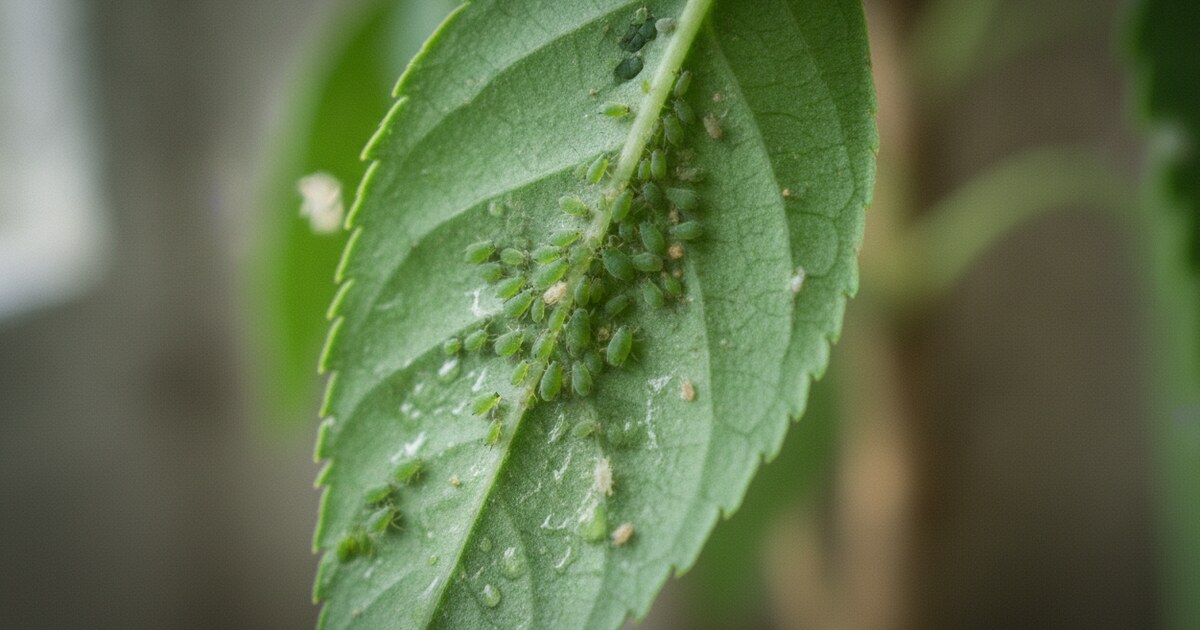
Aphids are 1/16 to 1/8 inch long (2 to 4 mm), pear-shaped, and soft-bodied. They cluster on the newest plant tissue: leaf tips, flower buds, and the undersides of young leaves. Colors vary by species, and the most common houseplant aphids are pale green or yellow. Others run orange, red, pink, beige, or black.
Indoors, aphid populations build faster than most plant owners expect. Unlike outdoor aphids that lay eggs, indoor populations reproduce through parthenogenesis: adult females give birth to live nymphs without mating. A single female produces 3 to 6 nymphs per day for several weeks, and each adult can generate roughly 100 offspring per week. In warm indoor conditions, nymphs reach reproductive maturity in fewer than two weeks. That explains why a handful of aphids on a new nursery plant can become a dense infestation within a month. Aphids enter the home on infested plants from the nursery, on clothing brushed against outdoor plants, or through an open window during warmer months. Common houseplant aphid colors include pale green (most frequent), yellow, orange, red, pink, and black. Size runs from 1/16 to 1/8 inch (2 to 4 mm). They target the softest new growth first: leaf tips, flower buds, and the undersides of recently unfurled leaves.
Signs Your Plant Has Aphids
You won’t always see the insects themselves first. Sticky residue on leaves or stems is often the first visible sign. That coating is honeydew, a sugary waste product aphids excrete while feeding on plant sap.
Watch for four signs together:
- Sticky, shiny patches on leaves or the surface below the pot
- Curled, puckered, or distorted new leaves where aphids are feeding on growing tips
- General yellowing of soft growth despite regular watering
- Black patches spreading across leaves — that’s sooty mold growing on the honeydew, a secondary infection caused by the aphids above
One more tell: ant trails climbing the stem. Ants farm aphids for their honeydew, so an ant highway up the plant almost always means aphids are somewhere above.
How to Get Rid of Aphids on Indoor Plants
Work through these steps in order. Skipping straight to spraying without first isolating the plant is the most common mistake.
Step 1: Isolate the plant. Move it away from all other houseplants. Aphids spread on leaf-to-leaf contact, and treating one plant while a colony migrates to another just extends the problem.
Step 2: Blast off the visible colonies. Take the plant to a sink or shower. Run a steady stream of lukewarm water across all surfaces, paying close attention to leaf undersides and growing tips. This step removes a large portion of the colony before any treatment touches the plant.
Step 3: Spray with insecticidal soap. Mix 2 teaspoons of liquid Castile soap with 1 quart of water. Spray every surface, including leaf undersides and stem joints. The soap breaks down the aphid’s soft outer membrane and kills on contact. Repeat every 3 to 5 days.
Step 4: Follow up with neem oil for stubborn infestations. If aphids reappear after a week of soap spray, switch to neem oil or alternate between the two. Mix 1 tablespoon of neem oil with a few drops of dish soap in 1 quart of water. Apply in the evening so the oil doesn’t sit under direct light. Neem works differently from soap: the active compound azadirachtin mimics insect juvenile hormones, disrupting aphid reproduction rather than just killing adults on contact.
Step 5: Prune heavily infested growth. If a stem tip is densely coated with aphids, cut it off. Pruning removes a concentrated colony faster than spraying alone. Seal the pruned material in a bag before putting it in the bin.
Keep treating for at least two weeks. Insecticidal soap kills on contact but leaves no residue, so it won’t stop the next generation from hatching. The 3 to 5 day repeat schedule targets each new batch of nymphs before they reach reproductive age.
Soap Spray vs Neem Oil: Which to Use
Both kill aphids. The difference comes down to speed versus staying power.
Insecticidal soap works on contact and shows results within hours. It’s the right first choice when you can see a visible colony. At 2 teaspoons per quart it’s gentle enough for most houseplants, and it rinses clean. The limitation: once the spray dries, it stops working.
Neem oil is slower but more persistent. The active compound azadirachtin mimics juvenile growth hormones in insects. Aphids that ingest or contact treated surfaces can’t molt or reproduce properly, which cuts off the next generation as well as the current one. For plants that keep getting reinfested from a persistent source, neem oil breaks the cycle faster than soap alone.
A practical approach: start with 2 soap spray applications 3 to 5 days apart, then switch to neem oil if aphids return after a week. The same soap-to-neem sequence works for whiteflies on indoor plants if you’re dealing with both pests at once.
How to Prevent Aphids on Houseplants
Most indoor aphid infestations start with a new nursery plant or a plant moved inside from the garden at the end of summer.
Quarantine new plants for 1 to 2 weeks. Keep them separate from your collection and check leaf undersides every few days before introducing them to the rest of your space.
Inspect weekly while watering. Flip a few leaves each session. Catching 10 aphids early takes 5 minutes to handle. Catching 10,000 later takes weeks.
Ease back on high-nitrogen fertilizer. Nitrogen-heavy feeding pushes out soft, fast-growing new tissue, and that’s exactly what aphids target first. If you’re fertilizing often during the growing season, scale back.
Keep plants in good condition overall. Plants stressed by overwatering, low light, or dry air attract pests more readily than healthy ones. Fixing the growing conditions matters alongside treating whatever pest turns up.
How PlantlyAI Helps You Confirm the Problem
Not every small pest on a houseplant is an aphid. Mealybugs, scale insects, and spider mite stippling can look similar early in an infestation. Treating for aphids when you actually have scale means applying the wrong product for weeks while the real problem gets worse.
PlantlyAI lets you photograph the affected plant and get an AI diagnosis in seconds. If it’s aphids, the app confirms it and gives you a step-by-step treatment plan with organic, biological, and chemical options. If it turns out to be mealybugs or something else entirely, you’ll know before spending two weeks on the wrong spray.
The app’s disease library also covers secondary infections. If sooty mold has spread from the aphid honeydew, PlantlyAI walks you through both the pest treatment and the mold cleanup in one session. Download PlantlyAI free on iOS or Android and run 2 free diagnoses per day with no account needed.
Frequently Asked Questions
Will Dawn dish soap kill aphids on plants?
Yes, but with caution. Dawn contains degreaser that can strip the waxy coating from plant leaves at higher concentrations. Plain Castile soap is gentler and works just as well. If Dawn is what you have, halve the dilution to 1 teaspoon per quart instead of 2, and test on one leaf before spraying the whole plant.
What kills aphids immediately?
Insecticidal soap spray kills aphids on contact within seconds. It breaks down their soft outer membrane and they die fast. The catch: it only kills aphids the spray physically touches. Any aphid hiding inside a curled leaf or on a stem you missed will survive, so coverage matters as much as the product.
Why do indoor plants get aphids?
Most indoor infestations arrive on new nursery plants, on clothing brushed against aphid-covered outdoor plants, or through an open window. Once inside, aphid colonies grow unchecked with no ladybugs or parasitic wasps to control the population. Heavy nitrogen fertilizing also produces the soft new growth aphids go after first.
Does soapy water spray kill aphids?
Yes. A mix of 2 teaspoons of liquid Castile soap per quart of water kills aphids on contact by disrupting their outer membrane. Spray every 3 to 5 days for at least two weeks to catch new generations as they hatch. Avoid soaps with added moisturizers or degreasers, which can burn leaves or leave residue.
How long does it take to get rid of aphids on houseplants?
Most infestations clear in 2 to 3 weeks with consistent treatment. Soap and neem oil don’t affect unhatched nymphs, so the 3 to 5 day repeat schedule is what makes the difference. Skipping even one application gives the surviving population time to recover.
Not sure what's wrong? Diagnose your plant free
Upload a photo to our free plant disease identifier and get an instant diagnosis.