Lemon Tree Leaves Turning Yellow: Causes and How to Fix It
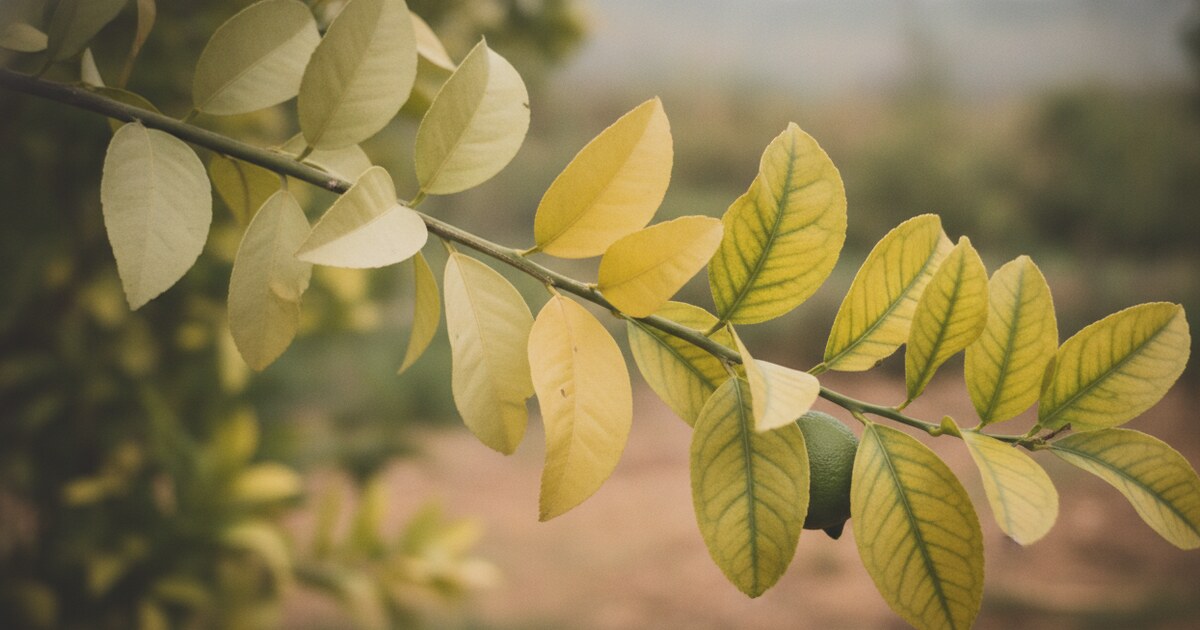
Yellowing leaves on a lemon tree always mean something. The question is which of the 7 common causes you’re dealing with, because nitrogen deficiency, overwatering, iron chlorosis, and root rot can all look similar in the early stages.
Lemon trees give you clear clues, though. Where the yellowing starts, which leaves go first, and what the soil feels like all point to the actual problem. This guide breaks down each cause and how to tell them apart so you can fix the right thing.
Quick answer: Lemon tree leaves turn yellow most often from overwatering, nitrogen deficiency, or root rot. The pattern tells you which: uniform yellowing on older leaves points to nitrogen or magnesium deficiency; yellowing at the edges with wet soil means overwatering. New leaves yellowing with green veins is iron chlorosis from soil pH that’s too high.
Why Lemon Tree Leaves Turn Yellow
Lemon trees (Citrus limon, family Rutaceae) are heavy feeders with specific requirements: soil pH 5.5–6.5, consistent moisture without waterlogging, and regular fertilization with nitrogen plus micronutrients including iron and magnesium. When any of these slip, leaves lose chlorophyll and turn yellow.
Understanding how citrus move nutrients is the key to faster diagnosis. Mobile nutrients like nitrogen and magnesium travel from old leaves to new growth when soil supply drops, so deficiency shows on older, lower leaves first. Immobile nutrients like iron can’t make that move, so deficiency appears on the newest growth at the tips. That one distinction narrows your diagnosis immediately.
Lemon trees grow best in USDA zones 9–11, though container trees thrive in cooler climates when brought indoors for winter. Container trees dry out 30–40% faster than in-ground trees and need checking every 3–5 days in summer heat. In-ground trees in warm climates need 1–2 inches of water per week during the growing season. Root rot fungi (Phytophthora parasitica and P. citrophthora) are the leading disease killers of citrus worldwide, thriving when roots sit in saturated, oxygen-depleted soil above 60°F. A tree can look healthy for weeks after root damage begins; yellowing typically doesn’t appear until 30–50% of the root mass is compromised and nutrient delivery collapses. Natural leaf shedding also causes yellowing that isn’t disease: healthy lemon trees shed their oldest leaves on a 12–18 month cycle, and a flush of lower-leaf yellowing in spring or fall often needs nothing more than patience. Cold damage shows below 29°F (−2°C), with stress symptoms starting as low as 40°F during prolonged exposure.
Overwatering and Root Rot
Overwatering is the most common cause of yellowing on container lemon trees. When roots sit in wet soil without oxygen, they suffocate and can’t deliver nutrients, even if the soil is full of them.
Signs: lower and mid-canopy leaves turn yellow, soil feels wet or soggy, the pot feels heavy, and the yellowing spreads upward over a few days. In advanced cases you’ll notice soft, dark roots and a musty smell when you unpot the tree.
To fix light overwatering, stop watering and move the tree somewhere with good airflow. Let the soil dry completely over 7–10 days, then resume watering only when the top 2 inches feel dry.
If root rot has set in, unpot the tree, trim any black or mushy roots with clean scissors, dust cuts with cinnamon powder, and repot into fresh well-draining mix (60% potting soil, 30% perlite, 10% coarse sand). Hold off watering for 5–7 days after repotting.
For an in-depth look at distinguishing overwatering from underwatering by leaf symptoms, see Overwatered vs Underwatered Plant: How to Tell.
Nutrient Deficiencies: Nitrogen, Iron, and Magnesium
Lemon trees are among the hungriest fruit trees in the home garden, and deficiencies show up fast. Three nutrients cause most of the yellowing you’ll see.
Nitrogen deficiency is the most common. Nitrogen is mobile, so the tree pulls it from older leaves to feed new growth when soil supply runs low. You’ll see uniform pale yellowing starting on the lowest leaves and working up the canopy while the tips stay green.
Fix it with a balanced citrus fertilizer (look for formulas with NPK ratios like 6-3-3 or 8-3-9) applied every 4–6 weeks during the growing season, or use a slow-release granular formula spread at the drip line.
Iron chlorosis looks similar but hits the newest leaves first. Young leaves at the tips yellow while the veins stay distinctly green, giving a net-like or striped pattern. This usually means soil pH is above 6.5, locking iron into a form roots can’t absorb. Test the soil; if pH is above 6.5, acidify gradually with sulfur granules or a citrus-specific acidifying fertilizer. Chelated iron foliar spray delivers fast temporary relief while the soil chemistry adjusts over 4–8 weeks.
Magnesium deficiency shows as interveinal chlorosis on older leaves. A broad band of yellow forms between the veins while the leaf edges and center rib stay green. It’s easy to confuse with iron chlorosis, but it hits the bottom of the canopy first, not the top. Epsom salt solution (1 tablespoon dissolved in 1 gallon of water) applied as a foliar spray monthly corrects it within 3–4 weeks.
Pests and Fungal Disease
Several pests trigger yellowing by feeding on leaf sap. Check the undersides of leaves carefully before assuming a nutrient problem.
Spider mites leave tiny stippled yellow dots scattered across the leaf surface, often with fine webbing on the undersides. They thrive in hot, dry conditions. Blast them off with a strong spray of water, then follow with neem oil spray every 7–10 days for 3–4 weeks.
Aphids and scale insects suck sap and excrete honeydew, a sticky substance that attracts sooty mold and blocks photosynthesis. Yellowing is gradual and usually comes with sticky or black-coated leaves. Insecticidal soap spray kills aphids on contact; scale needs 70% isopropyl alcohol on a cotton swab for individual removal plus horticultural oil spray for larger infestations.
For a full guide to diagnosing pest problems from sticky and discolored leaves, see Sticky Residue on Plant Leaves: Causes and How to Fix It.
Citrus greasy spot (Mycosphaerella citri), a fungal disease common in humid climates, causes yellow-brown oily blotches that eventually fall out, leaving holes. Copper-based fungicide applied once in late spring to early summer controls it effectively.
Natural Leaf Drop and Environmental Stress
Not all yellowing signals a problem worth treating. Several situations cause temporary yellowing that resolves without intervention.
Natural senescence: Lemon trees shed leaves that are 12–18 months old. This happens in cycles, most visibly in spring or fall. If it’s only the lowest few leaves and the rest of the tree looks healthy with firm green growth at the tips, the tree is doing exactly what it should.
Cold stress: Lemon trees show stress yellowing at sustained temperatures below 40°F, and leaves die below 29°F. If the tree was near a cold window, outside during a cold snap, or in an unheated garage, affected leaves yellow and drop over 1–3 weeks.
Move the tree somewhere warmer and wait. New growth emerging from the tips means the tree is recovering.
Transplant shock: Freshly repotted or moved trees often shed 20–30% of their leaves as the root system adjusts. The yellowing stabilizes within 3–4 weeks once the tree settles in.
Salt buildup in containers: Container trees fertilized repeatedly without deep flushing accumulate salts that block nutrient uptake. Flush the soil by watering slowly until water drains freely from the bottom, repeating the cycle 2–3 times. Do this every 3–4 months.
How to Diagnose Yellow Lemon Tree Leaves by Pattern
Matching the symptom pattern to the cause is faster than guessing. Use this table:
| Pattern | Most likely cause |
|---|---|
| Old, lower leaves yellow first; new tips green | Nitrogen deficiency |
| New leaves yellow with green veins (net pattern) | Iron chlorosis (soil pH too high) |
| Old leaves show yellow between veins; edges green | Magnesium deficiency |
| Lower to mid canopy yellowing; soil wet and heavy | Overwatering or root rot |
| Fine yellow stippling; webbing on leaf undersides | Spider mites |
| Yellowing with sticky or black coating on leaves | Aphids, scale, or whiteflies |
| Oily yellow-brown blotches that fall out | Citrus greasy spot (fungal) |
| Yellowing after cold snap or drafts | Cold stress |
| Bottom few leaves only; tree otherwise healthy | Natural leaf senescence |
When multiple leaves show different patterns at the same time, two problems are often happening together. The most common pairing is overwatering combined with a secondary nutrient lockout: waterlogged roots can’t absorb iron or magnesium even when both are present in the soil. Fix the watering first, then reassess the deficiency symptoms after 3–4 weeks.
If your lemon tree is curling leaves in addition to yellowing, see Lemon Tree Leaves Curling: Causes and How to Fix It for the full curl diagnostic guide.
How PlantlyAI Helps Diagnose Yellow Lemon Tree Leaves
Reading a pattern table works for clear-cut cases, but lemon tree leaves vary in how deficiency and pest damage look depending on the specific variety and growing conditions. PlantlyAI takes a photo of your specific tree and runs it through an AI diagnosis model that identifies the problem and gives you a step-by-step treatment plan, including organic, biological, and chemical options.
You get 2 free diagnoses per day with no account needed. Take one photo of the worst-looking leaves and another of the healthiest leaves for comparison. The app covers lemon trees, lime, orange, and all common citrus varieties, plus houseplants, vegetables, and garden flowers.
Download PlantlyAI from the App Store or Google Play and snap a photo of those yellowing leaves before choosing a treatment.
Frequently Asked Questions
Why are my lemon tree leaves turning yellow and falling off?
Yellow leaves that fall usually signal overwatering, root rot, or natural leaf senescence. If the soil is wet and yellowing started on lower leaves and spread upward, check the roots for rot. If it’s only the bottom few leaves on an otherwise healthy tree, it’s the normal 12–18 month shed cycle and doesn’t need treatment.
Can overwatering cause yellow leaves on a lemon tree?
Overwatering is the most common cause of yellowing on container lemon trees. Roots in saturated soil can’t absorb nutrients even when the soil contains plenty of them, so the result looks identical to a deficiency. Checking soil moisture before every watering session and using a pot with drainage holes prevents most cases.
Why are new lemon tree leaves yellow with green veins?
That pattern is iron chlorosis, and it’s caused by soil pH above 6.5. At higher pH, iron becomes chemically unavailable to roots even if iron is present in the soil. Test the soil pH and acidify with sulfur granules if it’s above 6.5. Chelated iron spray provides quick temporary relief while the soil chemistry adjusts over 4–8 weeks.
How often should I fertilize my lemon tree to prevent yellow leaves?
During the growing season (spring through early fall), feed with a balanced citrus fertilizer every 4–6 weeks. In winter, cut back to once every 8–10 weeks or skip entirely if the tree is dormant. Use a formula that includes nitrogen, iron, and magnesium. Container trees need more frequent feeding than in-ground trees because nutrients leach out with regular watering.
What’s the fastest way to fix yellow lemon tree leaves?
Identify the cause first using the pattern table above. For nitrogen deficiency, a liquid citrus fertilizer shows results within 2–3 weeks. For iron chlorosis, chelated iron foliar spray works in 7–14 days. For overwatering, letting the soil dry out fully before the next watering brings improvement within 3–4 weeks. Treating without diagnosing often makes things worse, so matching the symptom pattern to the right fix is always the faster path.
Not sure what's wrong? Diagnose your plant free
Upload a photo to our free plant disease identifier and get an instant diagnosis.